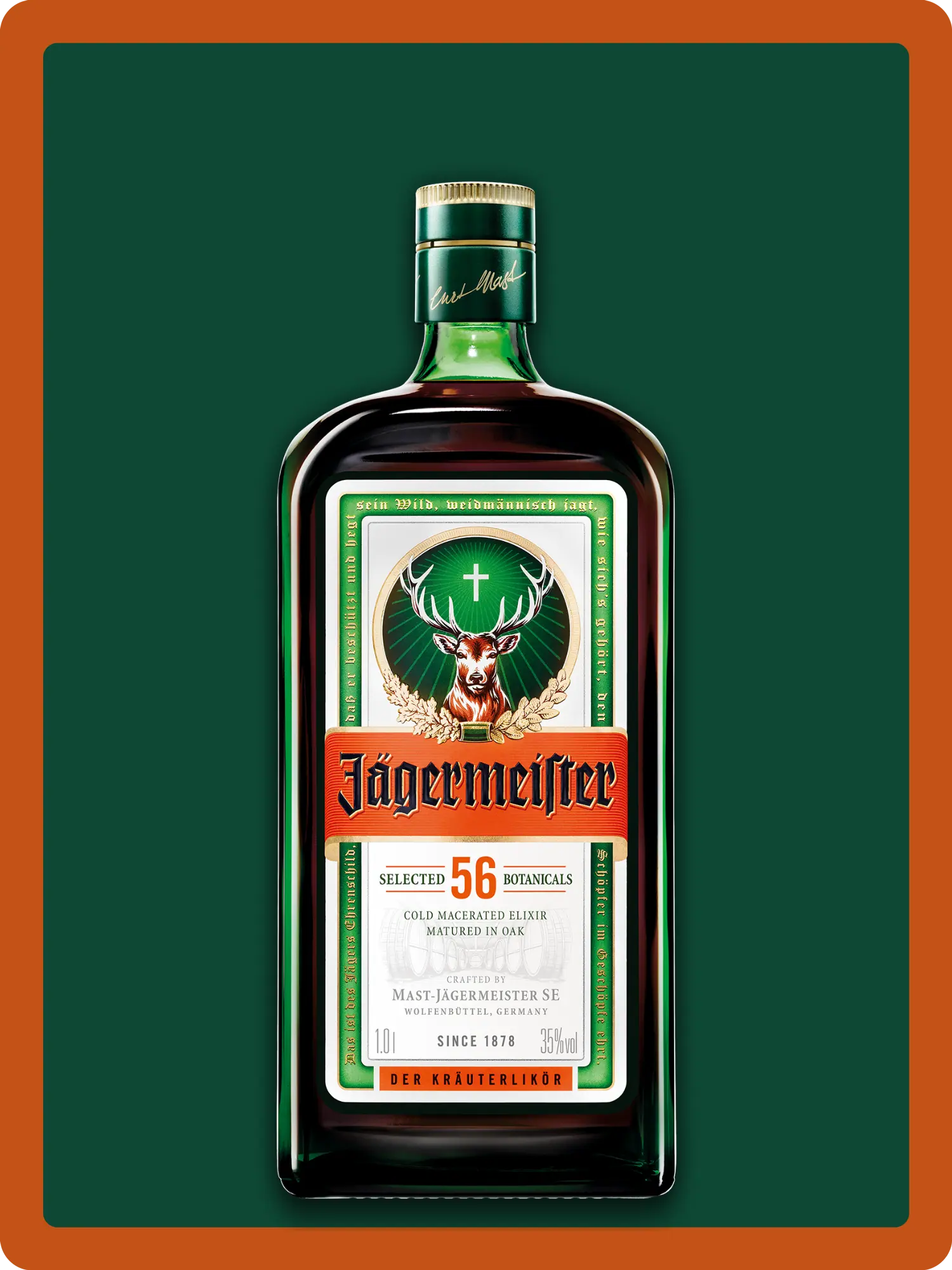
Origin: Germany
Alcohol content: 35% vol
Volume: 1000ml
Distillery

Jägermeister, also known as the Sacred Deer, is a liqueur from Germany and the number one alcoholic beverage brand in Germany. Jägermeister is a source of pride for Germans and a popular liqueur in bars abroad. Its popularity is directly proportional to the wildness of parties. "Jägermeister" is German, equivalent to "hunter master." Headquartered in Germany, Jägermeister has a 132-year history and is the number one alcoholic beverage brand in Germany.
Curt Mast, the first brewer of Jägermeister, was a hunter. Jägermeister wasn't originally an alcoholic beverage; it was a cough syrup. Because of the harsh German winters, hunters were prone to catching colds while working. To address this, the first Jägermeister product added alcohol to the cough syrup, along with ingredients to relieve digestive and respiratory symptoms, achieving the desired effect. From the beginning, Curt Mast believed that high-quality, stable bottles were crucial for his premium herbal liqueur. To find the ideal bottle, the inventor of Jägermeister had to be creative, thus developing many different models through breakage testing.
In 1934, Nazi Germany enacted the Reich Hunting Law, stipulating that only the most outstanding hunters could be called "Master Hunter Jagermeister." Shortly after the law's implementation, Hitler appointed the Commander-in-Chief of the Luftwaffe, "Grimm," as the head of the Master Hunters. In 1935, Jägermeister registered the "Jagermeister" trademark and officially began mass production. Before its release, Jägermeister was already deeply ingrained in the public consciousness, and at the time, it was known as "Germany's national spirit."
A total of 56 different natural ingredients contribute to the captivating flavor of Jägermeister, with herbs, flowers, roots, and fruits from around the world used in its secret recipe. A total of 383 quality checks were conducted before the final product was filled, resulting in a herbal liqueur that is unique in both quality and taste.
Since its invention 75 years ago, the Jägermeister recipe has remained unchanged, meticulously crafted by the master distiller. First, they precisely weigh the various ingredients and transform them into various dry blends. During the maceration process, herbs are placed in a mixture of alcohol and water for several weeks to extract flavor components, such as essential oils. Then, the distiller blends the different maceration ingredients with the base ingredients. The disclosed ingredients include juniper berries, ginseng, licorice, cinnamon, citrus peel, ginger, and fennel. These various ingredients are ground and blended in different proportions, then steeped in a mixture of approximately 70% alcohol and water for 2 to 3 days, allowing the aromas and colors of the plants to infuse into the liquid.
This steeping process is repeated many times, lasting about 5 months, until all the aromas and colors are fully absorbed into the base ingredients of Jägermeister. It is then aged in oak barrels for a year. Finally, this Jägermeister base is combined with alcohol, liquid syrup, caramel, soft water, and other ingredients for a final blend. In short, after a year of aging, alcohol syrup and other ingredients are added to create this 35% vol herbal liqueur.