{{ 'fb_in_app_browser_popup.desc' | translate }} {{ 'fb_in_app_browser_popup.copy_link' | translate }}
{{ 'in_app_browser_popup.desc' | translate }}
{{word('consent_desc')}} {{word('read_more')}}
{{setting.description}}
{{ childProduct.title_translations | translateModel }}
{{ getChildVariationShorthand(childProduct.child_variation) }}
{{ getSelectedItemDetail(selectedChildProduct, item).childProductName }} x {{ selectedChildProduct.quantity || 1 }}
{{ getSelectedItemDetail(selectedChildProduct, item).childVariationName }}
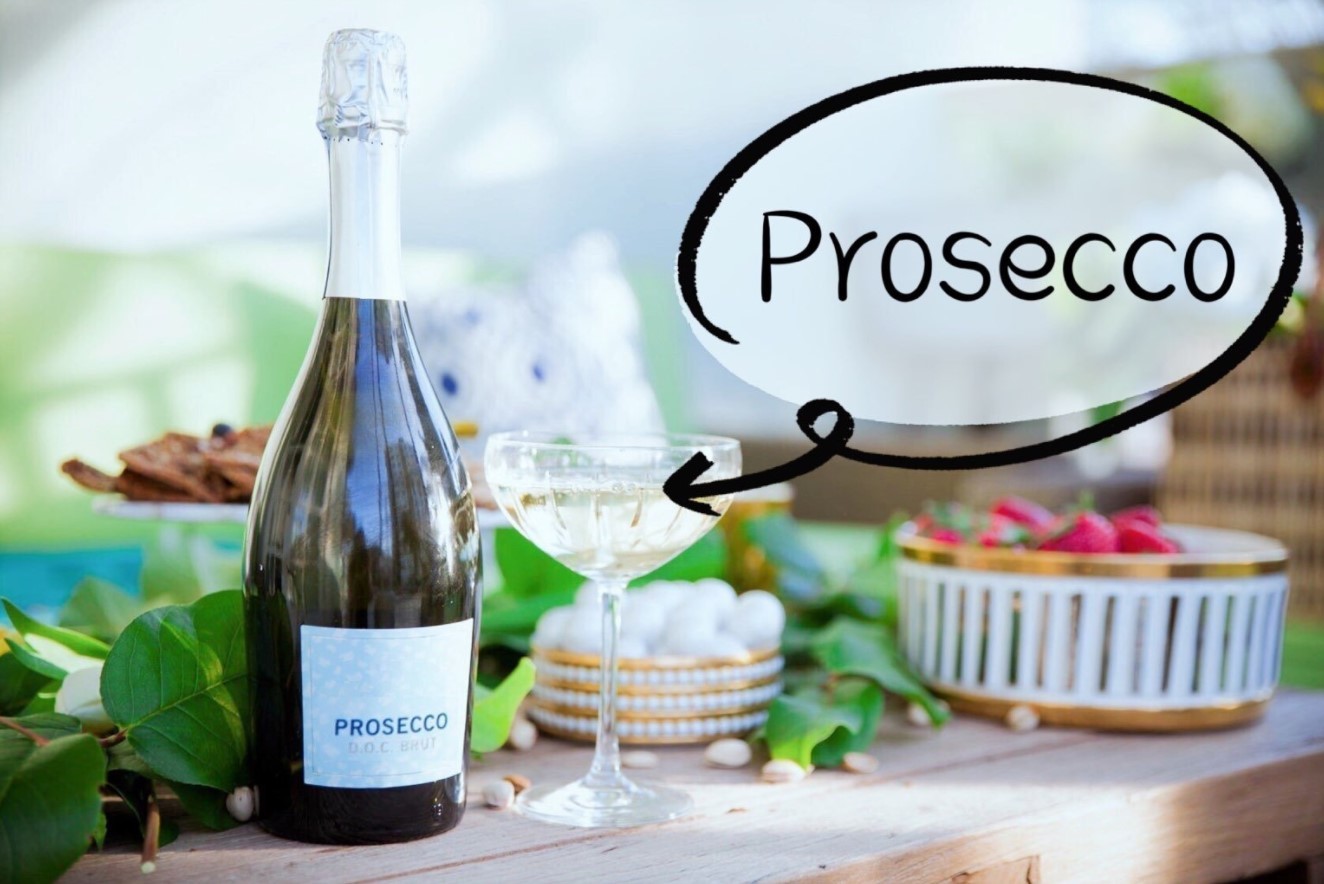
Italy Sparkling Wine - Prosecco
History
Prosecco sparkling wine is named after the village of Prosecco in the Friuli region of northeastern Italy. The earliest history can be traced back to 400 years ago. The early Prosecco was brewed using the Ancestral method, with a sweetness and low alcohol style, closer to Asti in northwest Italy. At present, Prosecco is mainly brewed by the Tank Method.
Flavor
Prosecco is usually light in body, low in acidity, low in alcohol, with the aroma of green apple and honeydew melon, and easy to drink. It has become the most popular and common sparkling wine, from the most common bars on the streets of Italy to the Michelin stars. Star restaurants, you will definitely see Prosecco!
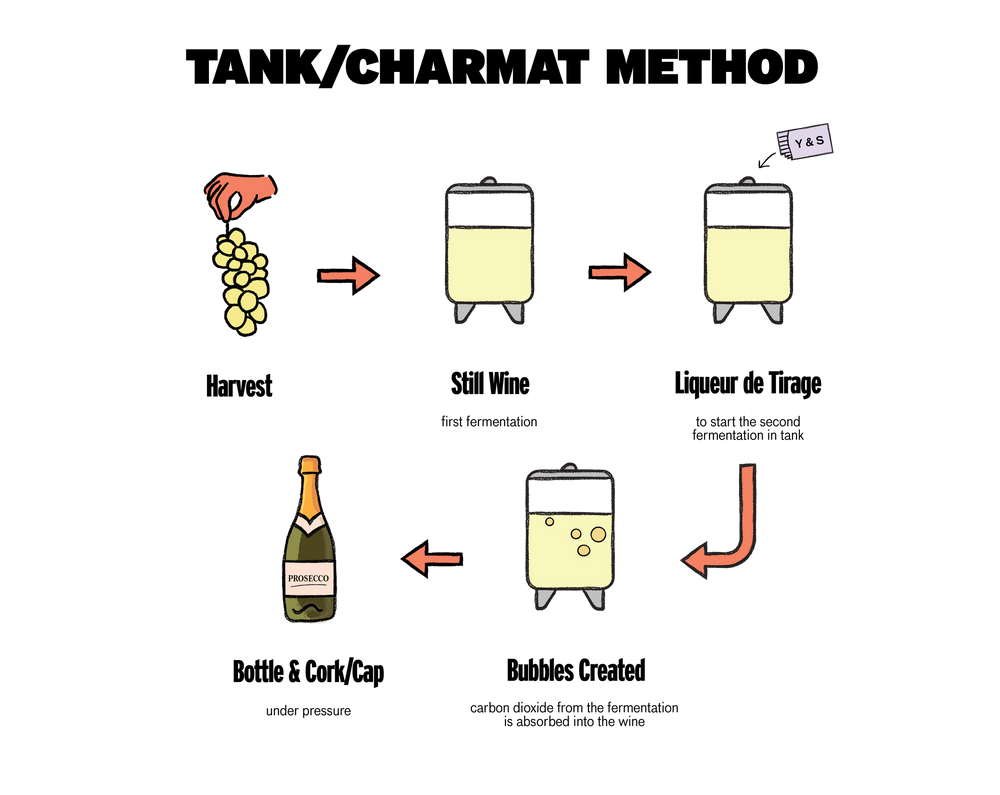
The major making method - Tank Method
After the first fermentation, the base wine is fermented for the second time in a sealed stainless steel barrel. During the process, a large amount of carbon dioxide (bubbles) will be produced, and the contact time with the yeast is relatively short (about 30 days), so that Prosecco can be made More fruity and floral aromas.
Grapes used in Prosecco
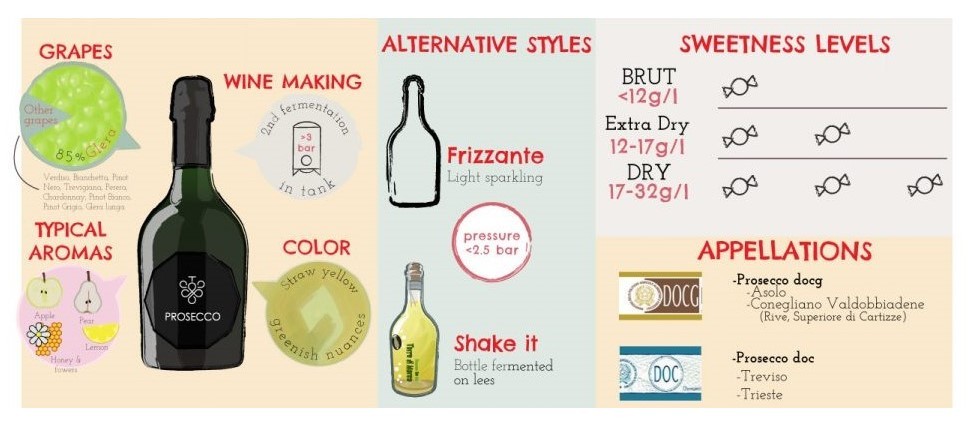
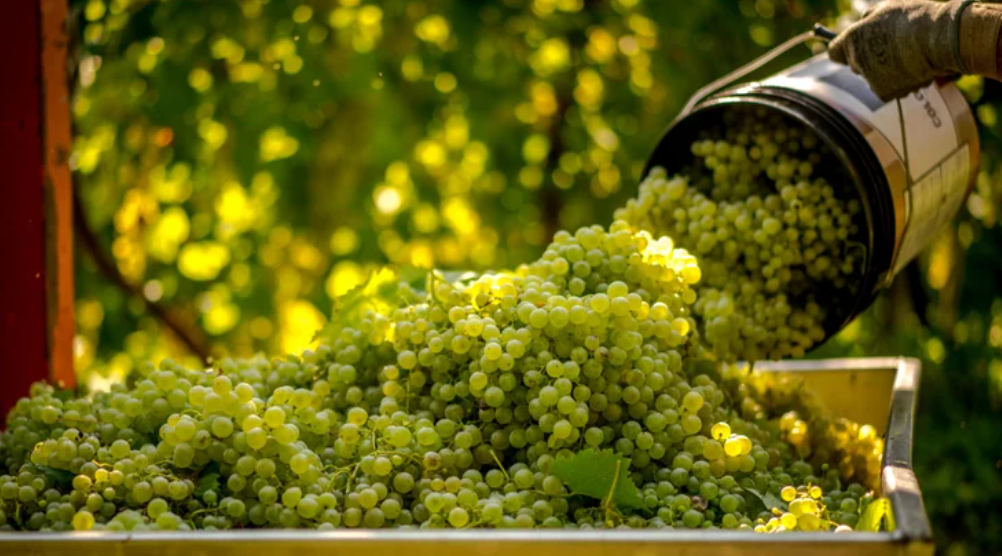
Prosecco is mainly brewed with Glera, but other grapes (such as: Verdiso, Chardonnay, Pinot Bianco, Pinot Grigio) are also used. The legal principle stipulates that 85% or more Glera be used to be called "Prosecco". Glera is a late ripening wine with fairly high acidity and often has aromas of white peach and soap. In addition to Italy, Glera is also grown in Australia and Slovenia.
Prosecco 使用的葡萄
產區規定使用85%或以上的Glera釀造,才能被成爲” Prosecco”。其餘部分常用 Verdiso、Chardonnay、 Pinot Bianco、Pinot Grigio釀製。Glera是一種白色葡萄品種,在威尼托和弗留利地區已經生長了數百年。較晚成熟、酸度相當高, 常帶有白桃和肥皂的香氣。Glera是一種高產葡萄,在這個季節成熟較晚。酸度高,口感中性,是起泡酒的理想選擇。除了意大利外,澳洲、斯洛文尼亞也有種植Glera。
產自Glera的意大利葡萄酒幾乎都是微起泡酒(frizzante)或全起泡酒(spumante)。還有一些靜止葡萄酒也是用Glera製造的,但其規模遠不及在全球廣泛出口的起泡酒。
Residual sugar level
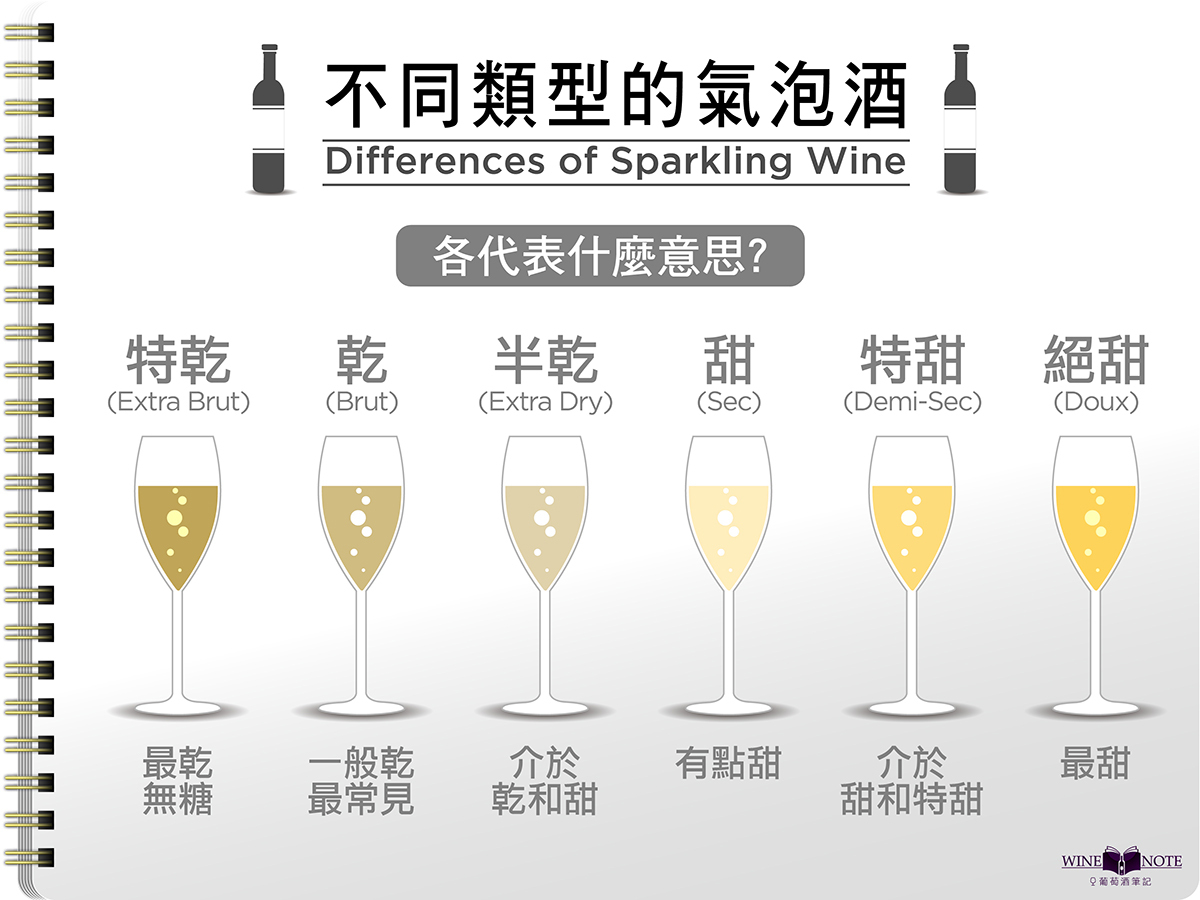
Prosecco can be divided into the following 4 categories according to the amount of residual sugar:
Brut: less than 12 g/l residual sugar
Extra Dry: residual sugar between 12 and 17 g/l
Dry: residual sugar between 17 and 32 g/l
Demi – Sec: residual sugar between 32 and 50 g/l
Region of Prosecco
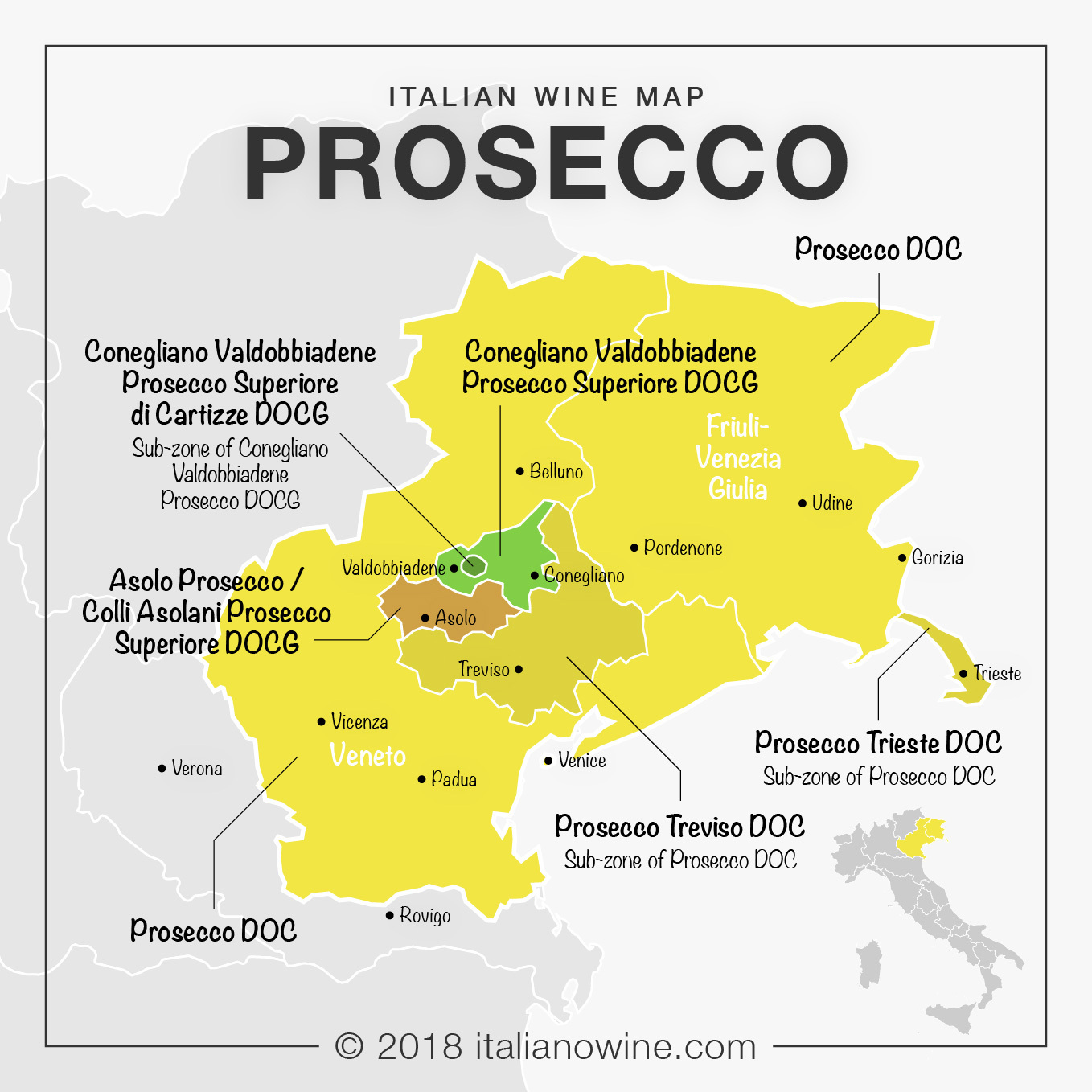
The Prosecco production area belongs to the DOC grade and is located in the Veneto and Friuli-Venezia-Giulia regions in northeastern Italy. The region covers many famous cities, such as Venice, Padova, and Treviso. In Prosecco DOC, the winery can specifically mark the Treviso and Trieste regions on the wine label.
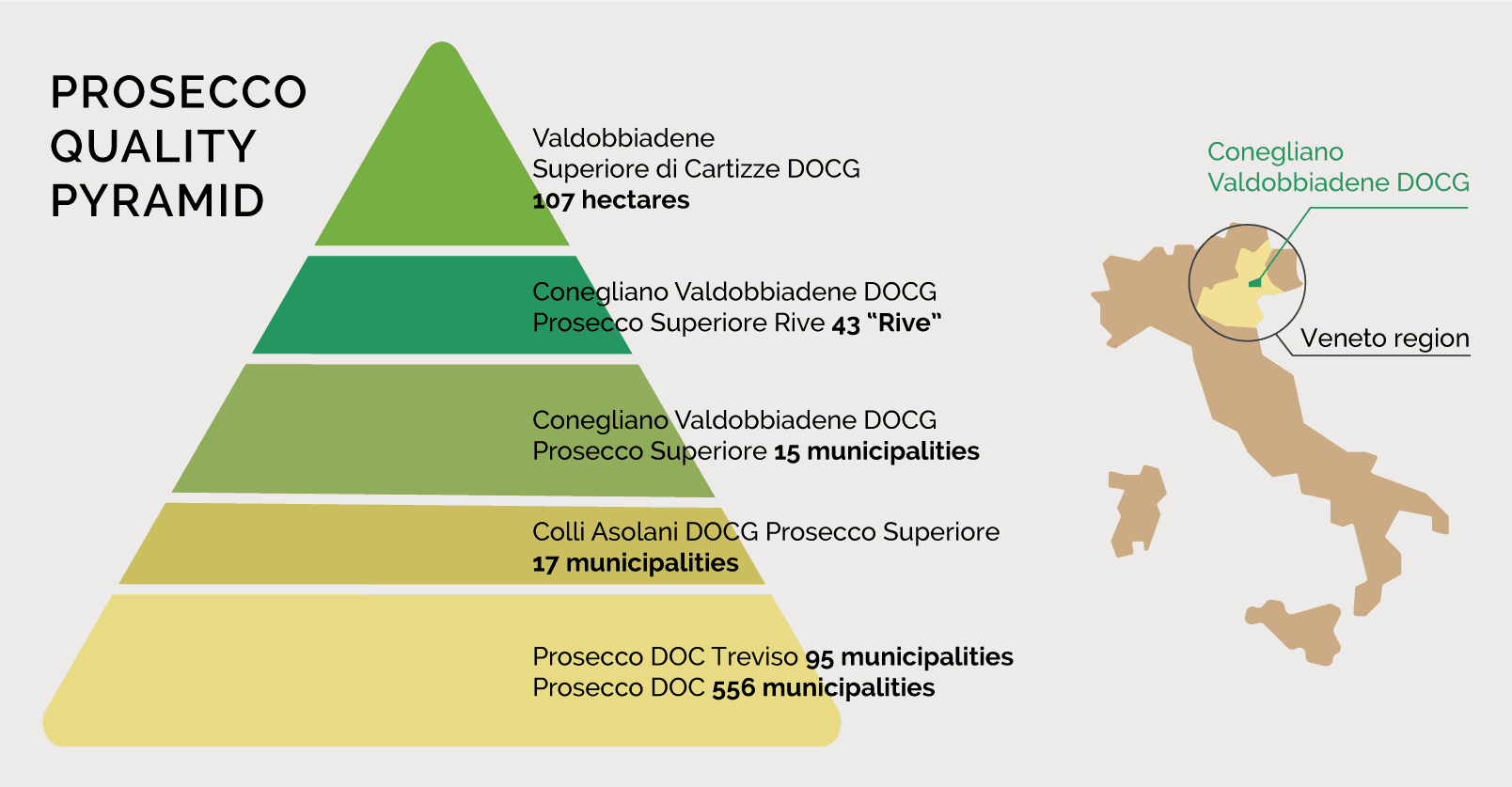
In addition, there are also DOCG-level sub-production areas, such as Prosecco Conegliano-Valdobbiadene Superiore DOCG, Prosecco Asolo Superiore DOCG, Superiore di Cartizze DOCG, etc. The soil in these production areas contains limestone, which gives it a more unique flavor. Better quality.
Prosecco Asolo Superiore DOCG
The production area was established in 2009. The production area is across the shore from the aforementioned Conegliano-Valdobbiadene. In addition, the terrain is low, with an altitude of up to 450 meters.
Conegliano-Valdobbiadene Superiore DOCG
The production area became DOC as early as 1969, and was upgraded to DOCG in 2009. The terrain is high and steep. In 2019, the local area even successfully applied for the United Nations World Heritage Site with its unique terrain. The wines in the production area are mainly floral. There are also two higher grades in the production area: Superiore Rive and Superiore di Cartizze. Among them, Superiore di Cartizze covers an area of only 108 hectares, which is quite rare.
Valdobbiadene Superiore di Cartizze DOCG
The production area was also established in 2009, and the local soil is mainly red clay. Blown by a cool breeze in the morning and warm at noon, the grapes can ripen while maintaining a refreshing style.
Food Pairing
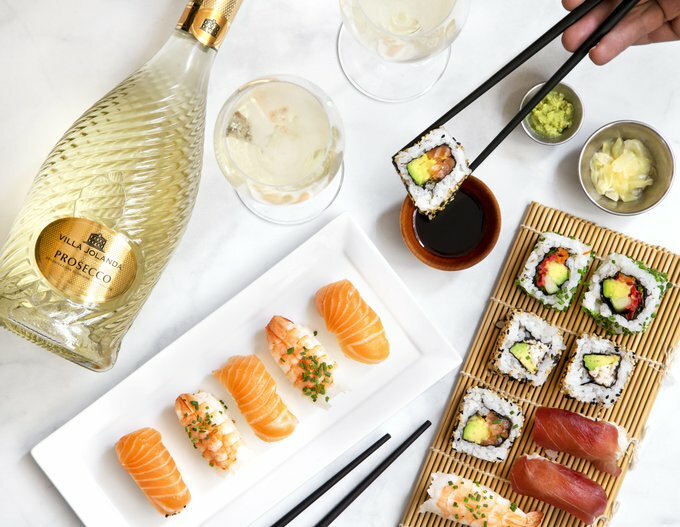
Prosecco is especially suitable for salmon and poultry dishes, sushi and sashimi are good choices. In addition, it is also suitable for food with some nuts (almonds, hazelnuts, cashews) and cheese (Mozzarella, Gorgonzola, Ricotta).
Reguta Winery
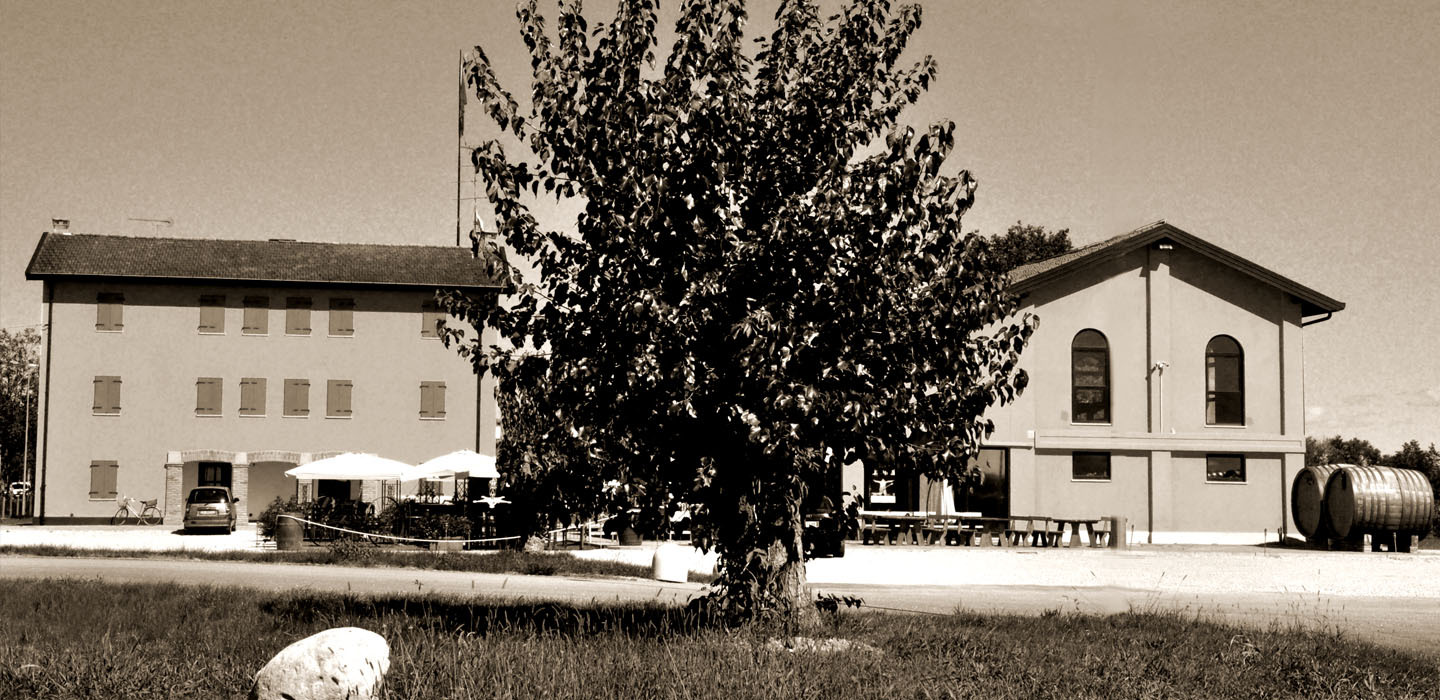
Reguta Winery was founded in 1928 by Ettore, Italy. Ettore passed on his experience to his descendants and cultivated the land with a great sense of belonging. In this area of the province of Udine, near the Friuli Riviera, an ideal territory is found, so much so that it is the domain of premium Friulian DOC wines. Currently, Giuseppe and Luigi Anselmi (Luigi Anselmi) are in charge of running Reguta winery~
There are currently 250 hectares of vineyards. Due to the location close to the sea, affected by the sea breeze, the soil is clay rich in mineral salts. Among them are many different local grape varieties, such as Refoscodal peduncolo rosso, Fruulano, Pignolo, RibollaGialla or Verduzzo, etc., as well as international varieties, such as Merlot, Pinot Noir, Chardonnay or Cabernet Sauvignon. The winery is one of the main producers and bottlers of Friuli-Venezia Giulia and Prosecco DOC Spumante
Selection of Reguta Prosecco
Selection of Other Prosecco
Prosecco Sparkling Wine